
THE OPEN
Tom Brady ran his card shop for eighteen months before he let anyone else in, and then JAY-Z, Aaron Judge and Dana White all wrote checks. Megan Thee Stallion signed with a major label and kept every master and every publishing dollar. Drake put five MLB teams into an OVO collection this week, and that's the smaller half of his apparel business. Welcome back to The Closeout. Let's get into it.
THE LEAD
If You Build It, They Will Come

Issue #13 ran CardVault in the Deal Sheet: Brady owns 50%, bought in February 2025, grew it from a handful of stores to 17, targeting 100-plus. That item published on a Wednesday. On Thursday the company announced its first strategic investor group, and the list reframed everything.
Gerry Cardinale of RedBird. JAY-Z. Silver Lake co-CEOs Egon Durban and Greg Mondre. Lee Fixel of Addition. Todd Graves of Raising Cane's. Adam Edmunds of Entrata. Wyc Grousbeck of the Celtics. John Henry of Fenway Sports Group and Linda Henry of Boston Globe Media. Aaron Judge. Connor McDavid. The Kraft Group. Dana White. Brady's manager Ben Rawitz and his production company Shadow Lion round it out.
Neither the size of the round nor the valuation was disclosed. That absence is doing work, and it tells you the money was never the point of the announcement.
Read the list again by what each name controls. Cardinale and Silver Lake move sports media rights. Henry owns a baseball team and a newspaper. The Krafts own a stadium and the retail corridor around it. Grousbeck owned an arena tenant. White runs the most aggressive live-event machine in sports. Judge and McDavid are the two most collectible active athletes in their leagues. A card shop needs foot traffic, licensed inventory, and a reason for people to show up on a Tuesday. Every investor on that list owns a piece of at least one of those.
The sequencing is what separates this from the usual celebrity round. Brady didn't sell the idea. He bought half a business, ran it for eighteen months, tripled the footprint, then brought in people who could each unlock a different door. Capital was available to him the entire time. He waited until he had something worth attaching it to.
Issue #13 covered Hopkins buying into Whatnot back in 2021, when selling things over a livestream was still a novelty. Whatnot is now worth $20 billion, and trading cards are one of the biggest things moving through it. Brady is selling the same product out of seventeen storefronts.
CardVault co-founder Ed Kane said they wanted builders, not passive money. That's a standard the group has to meet in public now.
DEAL SHEET
Aliyah Boston is now a co-owner of Sequel, the tampon brand founded by Amanda Calabrese and Greta Meyer that already sponsored her team. She took equity instead of cash for social posts and campaigns. No stake or valuation disclosed. Her logic: a one-time check can't appreciate.
Travis Kelce launched TEKTA, an NIL consulting venture with Publicis Sports reaching 45,000 Division I athletes across 68 Power Four schools. The strategic operating partner is 3 Arts Sports, the agency that represents him. No ownership stake disclosed, which is loud from a guy who's part of a group holding 9% of Six Flags
LeBron James launched a golf channel on YouTube August 15 with a 90-minute Cavaliers reunion shot at Castle Stuart in Scotland. Monthly episodes, past 200,000 subscribers out of the gate. No partner, no terms, no structure announced. The channel is his. Whatever gets sold through it later will be too.
Ashton Jeanty invested in Nukleus, a platform where athletes join free and their agents, lawyers, CPAs and advisors pay the subscription. Terms undisclosed. His framing: you become a CEO the day you get drafted, ready or not. So he bought into the layer that bills his own staff.
Jon Jay and Tyson Ross joined BrknPar, Andy Katz's sport tech fund, as Athlete Venture Partners, committing capital alongside it and running diligence. Both still work inside front offices, Jay with the Cardinals, Ross with the Dodgers. The fund won't disclose its size. What they're buying is reps, not returns.
OFF THE STAGE
Megan Kept the Masters

She left 1501 Certified Entertainment after years of fighting over royalties and creative control, settled in 2023, and built Hot Girl Productions to hold everything herself. In February 2024 she cut a distribution deal with Warner that let her stay independent while borrowing a major's reach. On August 14 she did it again, this time with Interscope.
The terms matter more than the logo. Interscope handles global distribution and support. Megan keeps complete ownership of her masters and publishing, releases through Hot Girl Productions, and brought Roc Nation in alongside. Steve Berman signed off from Interscope Capitol. Roc Nation CEO Desiree Perez framed it as continuity rather than a new chapter, which is accurate. This is the second time she's run the same play, and the second time a major agreed to her structure instead of the other way around.
No dollar figure was disclosed, and asking for one misreads the deal. The valuable thing here is a catalog she'll still own in thirty years, and a template that gets cheaper for her every cycle she proves it works.
Issue #12 covered Beyoncé buying LVMH out of SirDavis because a minority position wasn't the goal. Megan never let a majority position exist to buy back. One of them paid to get the whole thing. The other refused to hand it over.
Act III is coming.
THE DROP
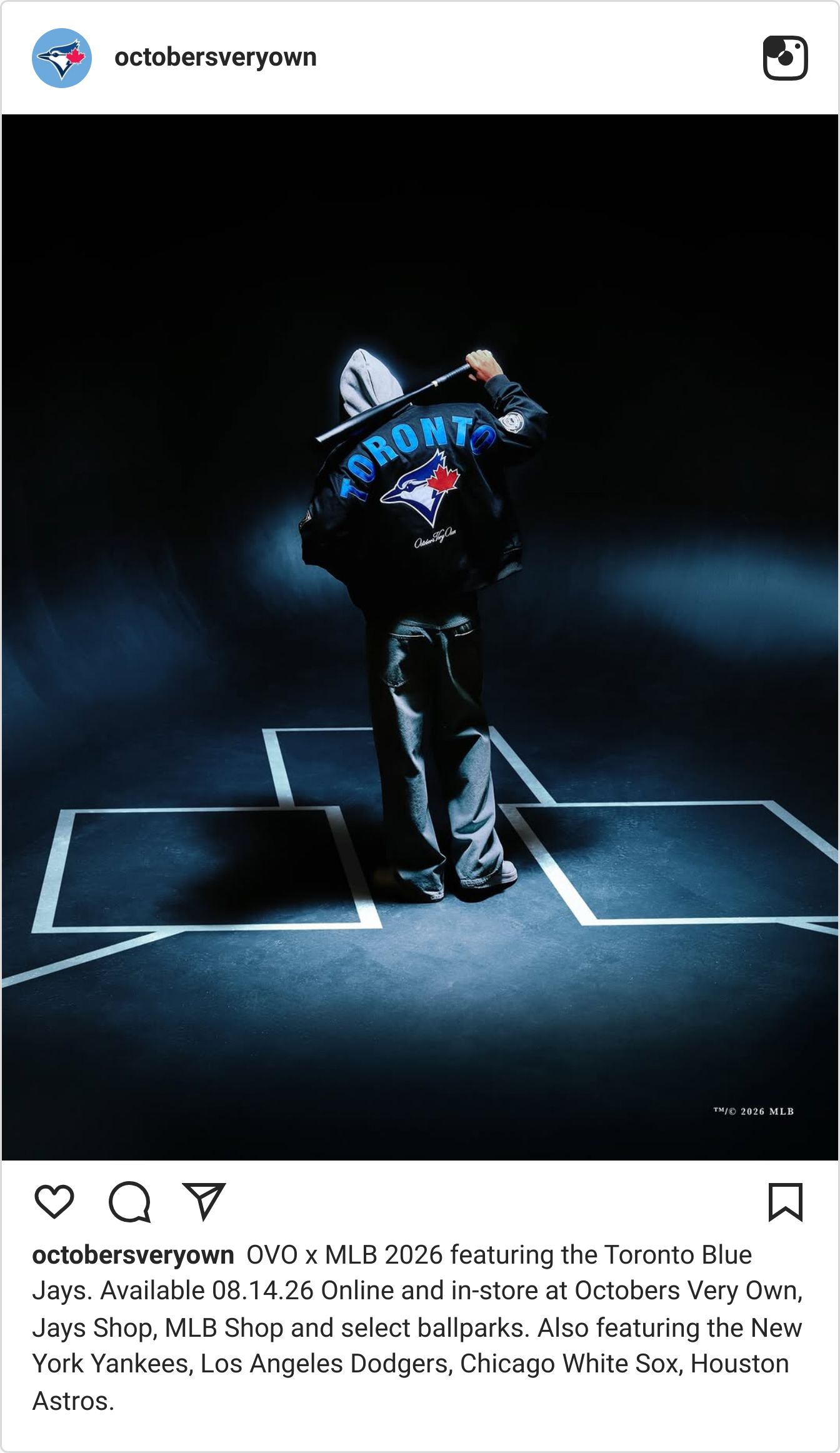
OVO x MLB, 2026 edition. Drake's label returned August 14 with five teams: the Blue Jays out front, plus the Yankees, Dodgers, White Sox and Astros. Varsity jackets, pinstriped baseball jerseys, hoodies, tees, accessories. Selling through OVO, Jays Shop, MLB Shop and select ballparks.
Worth noting the playbook MLB is running here. The league has licensed its marks to Supreme, BAPE, Awake NY, Eric Emanuel, Born X Raised, Aimé Leon Dore and KITH, and in Issue #2 we covered Jerry Lorenzo's multi-year Fear of God partnership, which opened in 2020 with a Negro Leagues capsule before it ever touched a current club. None of that is accidental. Fitteds and jerseys have been hip-hop uniform for forty years, a team logo doing the work of a neighborhood flag long before the league had an opinion about it. MLB didn't build that equity. It's paying to get back inside it.
Drake is running two modes inside the same shift. With MLB he licenses league marks and sells them at OVO prices. With football he supplies the club. NOCTA has made Venezia's kit since 2024-25, the season after he invested, a detail buried in our Issue #1 Lead. This June it designed Canada's pre-match capsule inside Nike's X2 program, alongside Palace for England, Jacquemus for France and Virgil Abloh Archive for the USA. The Cryoshot Tiempo '94 ran $210, the track jacket $135, the tee $60. Nike still designed Canada's actual match kits back in March. NOCTA got everything the players wear walking in.
The MLB collection is the business he's already good at. The kit work is the one worth watching. One puts his logo on a jersey. The other puts him inside the crest.
WORTH A WATCH
Jaylen Brown on Mental Wealth (Boardroom x Ally Bank)
Rich Kleiman and Ally's Jack Howard get the new Sixers forward talking about what money did to his relationships, and Brown calls it one of the more vulnerable conversations he's had. The operational details are the payoff: he tracks every dollar and requires three approvals before anything moves. Then he turns the question back on Kleiman and asks how you ask for help when everyone assumes you have it figured out.
P.S.
NIL turned college athletes into small businesses overnight, without giving them any of the infrastructure that word usually implies. What do you make of it? Hit reply. See you next week
